
In recent times, the term pidgin, despite its linguistic nature, has become quite widespread in non-academic circles, and many people have already incorporated it into their vocabulary. However, it is not always used in the right way, so it is important to make some considerations in this respect.
When we talk about the concept of pidgin, we can distinguish two different meanings. In a narrow sense, pidgin is defined as a marginal language that arises to meet certain limited communication needs between people who do not have a common language. In a broad sense, however, pidgin refers to any form of reduced and simplified speech that can occur whenever there are linguistic exchanges in which sender and receiver do not share the same knowledge of the code: speech with children, speech with foreigners (in markets, hotels, guides…), with the hearing impaired.
Of these two notions, we will focus on the first one, which is the most widespread. However, this first approach to the concept of pidgin has helped us to extract two fundamental characteristics: on the one hand, the fact that it is a phenomenon that occurs in a context of contact between different languages; and, on the other hand, that this phenomenon is characterized by the simplification of the forms of language, a fact that responds to a practical purpose, as we shall see.
The concept of ‘pidgin’. General characterization
As we have already mentioned in the introduction, pidgin is a simplified language, created and used by individuals from communities that do not have a common language and do not know enough of any other language to use it among themselves. Pidgin languages have been common throughout history in situations such as commerce, where the agents involved in the commercial activity spoke different languages; and, above all, in the colonial context, where two or more different cultural groups came into contact with each other and had to understand each other.
In essence, a pidgin is a simplified code that allows for brief linguistic communication, with simple and haphazardly constructed structures using conventions. A pidgin is not the mother tongue of any community, but a second language learned or acquired for a practical purpose. Its function is to satisfy the communication needs of individuals or groups of individuals who do not have a common language, but it is not used by any community to communicate among themselves.
In fact, pidgin languages arise from the contact between two varieties of unequal prestige or social consideration, for example, Jamaican English or West African Sango pidgin. They have sometimes been considered lingua francas of commerce; however, they are not always linked to this activity.

Pidginization vs. Creolization
The process of creating a pidgin language is called pidginization. A pidgin emerges in a very unstable way and gradually stabilizes on the basis of the grammar and phonology of the less prestigious language and the lexicon of the dominant language. Over time, a pidgin may give rise to a more elaborate or expanded system; and, when contact is prolonged and the pidgin develops, it expands functionally and begins to be spoken as the mother tongue of a community, it then becomes a creole language (e.g., Curaçao Papiamentu, derived from Spanish).
But not all pidgins develop this process of Creolization; some do not go beyond the stage of elaborated pidgin and others may undergo the opposite process, depidginization, and gradually disappear or cease to be used when the situation that led to their appearance (whether commercial, colonial or any other) changes.
In short, pidgins are learned as a second language to facilitate communication, while creoles are spoken as a first language. Creoles have larger vocabularies than pidgin languages and more complex grammatical structures; pidgins, on the other hand, are characterized by the simplicity of their grammar.
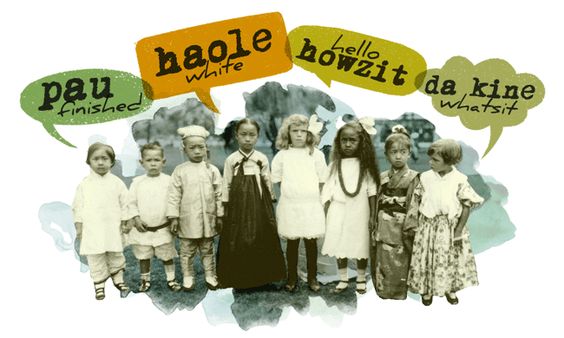
So where does this confusion between pidgin and creole come from? Certainly, the fact that many Creole speakers often refer to the language they speak as ‘pidgin’ does not help. For example, speakers of ‘Hawaiian pidgin’ actually speak Hawaiian Creole English, even if they refer to their language as pidgin.
Academic opinion is divided as to how creole languages develop, but the mainstream holds that pidgins form and then evolve into creoles. However, the turning point is precisely when ‘nativization’ occurs, that is, at what point do the children of parents who speak a pidgin language as a second language grow up as native speakers in that language. Basically, pidgin is used as a temporary means of communication to respond to a concrete need for communication. Therefore, when this notion of temporality or ‘situationality’ is lost, the status of the language changes. Some pidgin languages evolve into creoles, but others die in the process. In some cases, however, the dominant language (for example, that of a colonizing power) ends up imposing itself on the pidgin, tricking its possible evolution into Creole.

An example of pidgin: the sabir
Sabir, originally lingua franca, was a pidgin language used between the 15th and 19th centuries by Mediterranean sailors and merchants in ports and countries of Romance languages, especially by Genoese, Venetians, Occitanians and Catalans. It was a language that was almost exclusively oral, a fact that has hindered its subsequent study.
Sabir borrowed its lexicon and part of its grammar from various Romance languages and other Mediterranean languages. It is estimated that the earliest version directly adopted terms from Latin, adapting later mainly to the evolution of Italian, and secondarily from Spanish, Occitan, Catalan and Portuguese. Subsequently, some terms from Arabic, Greek and Turkish would have been incorporated, especially in the easternmost parts of the Mediterranean.
Miguel de Cervantes, in chapter XLI of the first part of Don Quixote, makes an explicit reference to the Sabir when he mentions the existence of “a language that is found throughout Barbary and even in Costantinople among captives and Moors, which is neither Moorish nor Castilian nor of any other nation, but a mixture of all languages, with which we all understand each other”.
For example, the following is an example of the Lord’s Prayer in the Sabir language:
Our father,
who art in Heaven,
Hallow be thy name.
Thy Kingdom come,
Thy will be done on earth as in heaven,
for ever and ever, Amen.
In short, pidgin is a linguistic variety that emerges from two or more languages with a practical and immediate purpose, which is to satisfy the needs of communication between individuals or groups of individuals who do not share a common language. From a purely linguistic point of view, it seems to be widely held that there is no difference between a pidgin language and a creole language, but that the distinction between the two concepts is determined by their stability as a communication system. Sabir, a language that has now disappeared, is a clear example of a pidgin language that arose for a specific purpose in a mercantile context.
Carlos Sánchez Luis