
Nowadays, audiovisual resources are an essential tool in the academic and professional environment. In this sense, the textual supports that serve as the basis for video and audio files are what ultimately make it possible to produce all kinds of audiovisual material, such as reports, exhibitions, podcasts, short films, documentaries, etc.
In many cases, these audio or video documents are conceived as a type of support or complementary material; however, it is important to understand that audiovisual materials represent academic, pedagogical and didactic resources in themselves and, therefore, require prior planning and rigorous execution in their preparation process.
The script
The script is the basic text that defines the structure of any audiovisual production. Any script comprises a written discourse through which it is possible to convey a specific message or to describe a fact, action or sensation. In other words, the script specifies in writing what the viewer will see and hear; it also records the order and timing of the narration, images and graphic resources that will appear on the screen.
For these reasons, the script is the main written reference of the audiovisual product used in the pre-recording, production and realization processes, which ultimately allows the construction of the audiovisual story in its entirety. Keep in mind that scripts are often rewritten or edited constantly during these processes, hence the importance of carrying out a rigorous and precise pre-writing exercise that defines and organizes the structure of the product.
The script is, in essence, the skeleton on which the final audiovisual product is built.
Sometimes, the script may be accompanied by a storyboard, which reflects the sequence of the product through a set of illustrations that function as a preview of the contents to be produced. Thanks to this script, it is easier to observe a large part of the events of the story and to know if there is coherence in it.
The literary script
Within the scripts for audiovisual format, we can distinguish two main typologies: the literary script, on the one hand, and the technical script, on the other hand.
The literary script is the first version of the script, where the story, characters, dialogues and actions are described (i.e. everything that has a narrative component). In the cinematographic field, it is estimated that a page of script generates approximately one minute of screen time, while its reading time should be about 15 to 20 seconds. The message must therefore be conveyed as clearly and concisely as possible.
In this sense, one of the most frequent mistakes when preparing this type of scripts is to be too meticulous in the descriptions.
Among the main characteristics of the literary script, which is usually written by the scriptwriter, we can highlight the following:
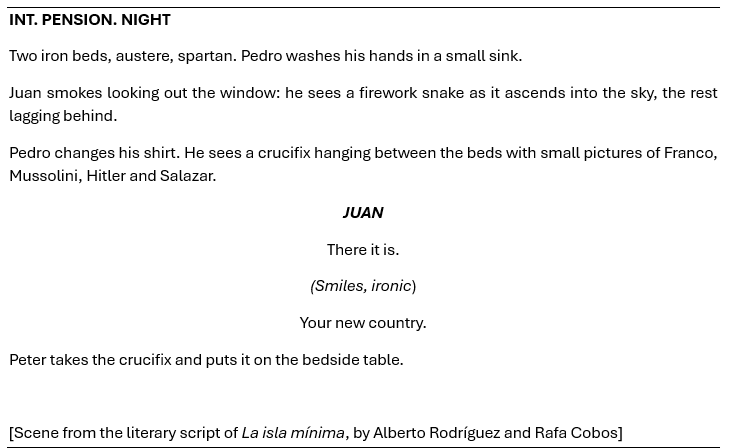
- In the lefthand margin, in capital letters, include the heading or caption: interior/exterior, location (without going into details), day/night, etc.
- The description of characters, places and actions occupies the entire width of the page. They must be precise and brief. They are always written in the present tense.
- The dialogue is placed in the centre of the page, introduced by the name of the character in question written in capital letters.
- Stage directions for the actor are written in brackets below the name of the character speaking and only if they are essential.
- Scenes are not listed (this is left to the technical script).
Let’s look at it through an example:
The technical script
Once the literary script is finished, we proceed to the development of the technical script, which is nothing more than the planning of the literary script to take it to the screen. This is a much more private document, prepared by the director to visualize the film before shooting (few people have access to it).
The story is broken down into shooting units or shots. It is from the technical script that we can really start talking about the filming process.
Some of the information found in a technical script includes scene number, shot number, framing, camera and character movement and direction, angle, decoration, sound, lighting, special effects, etc.
Writing of audiovisual scripts
The following are some of the issues to be taken into account when writing an audiovisual script. It is worth mentioning that these characteristics are mainly applicable to literary scripts:
– First of all, it is convenient to define the type of audiovisual product we want to produce, mainly according to its communicative intention: descriptive, argumentative, narrative, didactic, promotional…
– In the construction of the script, we must prepare a preliminary draft that includes the following elements: the theme or central idea (it should not occupy more than one sentence), the synthesis of the story (following the traditional scheme of beginning, middle and end) and the outline, which is the relation of the sequences ordered narratively, where the moments of greatest interest are fixed.
– The audiovisual material requires a remarkable capacity for synthesis, so each word that is said or read must have been strictly selected. It is convenient to use precise words, without extending the speech beyond what is necessary (avoid anything superfluous).
– It is important to use appropriate language from the sound point of view, with which the audience can easily identify, applying the rules of oral language and avoiding the use of overly elaborate concepts.
– Clarity and conciseness are essential in terms of lexis and grammar, so it is advisable to avoid complex subordinates and to use the present tense and only one type of personal pronoun. In summary, a simple wording.
– Finally, it is convenient to highlight ideas, words or concepts that have a greater relevance in the narration, marking pauses and silences where it is considered necessary to maintain the dramatic tension.
Although the scriptwriter is usually in charge of writing the scripts, there are many other workers involved in their production, including professionals specialized in the writing of audiovisual content. At the FAST.txt translation agency, we are also dedicated to the creation of content, and we have a team of experts trained in copywriting and with a long experience in the audiovisual sector (film, television, streaming platforms…). So, if you need to hire a service with these characteristics, do not hesitate to contact us: you can trust FAST.txt
Carlos Sánchez Luis