
When we talk about Latin, it is easy to make a brief general description of this language, especially if we take into account that it is the common trunk from which all Romance languages originate. Latin is an Indo-European language belonging to the Italic branch of languages. It was originally spoken in the Lazio region (around the city of Rome) and was the language of the ancient Roman civilization, becoming the cultural link of much of the Mediterranean region. As the Roman Empire expanded, Latin split into two main forms: on the one hand, the Latin we know as ‘classical’, the formal language used in administration and literary production; and, on the other hand, ‘vulgar’ Latin, which was the form of the language spoken by the lower classes and which in time would derive into the various Romance languages (Spanish, Italian, French, Portuguese, and Romanian, etc.).
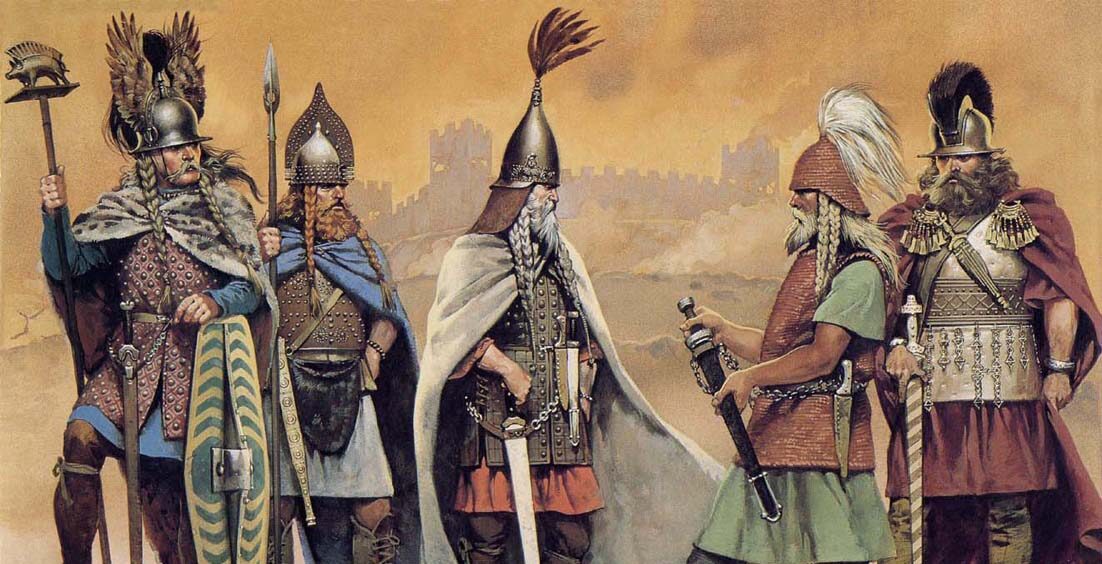
However, what many people do not know is that Latin, for most of its existence, coexisted with another linguistic group that could influence not only the development of the Latin language itself, but also of future Romance languages. Certainly, we are referring to Celtic.
Who are the Celts?
Celtic refers to a set of Indo-European languages that were spoken by the Celtic peoples who inhabited various areas of Europe in antiquity, from the British Isles to the northern Iberian Peninsula, and from the northern regions of Italy to the western parts of Turkey. Its origin is uncertain, although it is believed that part of the inhabitants of this linguistic family may have come from Anatolia or from the steppes between the Black Sea and the Caspian Sea, spreading from there to Western Europe.
The geographic subdivision of these peoples has led some scholars to classify the Celtic languages into two distinct groups: continental Celtic languages, including Celtiberian and Gaulish, and island Celtic languages, including, among others, el Breton, Gaelic or the Irish.
The Celtic term (keltoi) is of Greek origin, and they may have taken it as a result of their contact with the Iberians in the Iberian Peninsula. This term was later Latinized as celtae, to give rise to the current Celts. The Greek root of this word is related to a nation of fighters. However, the Celts probably called themselves *gal-, that is to say, Gauls.
These Celtic peoples shared a number of common characteristics: they were organized in tribes, had a priestly class of great importance (the famous druids), practiced polytheism (with a special emphasis on nature worship) and were a warrior nation.
Romans and Celts: a long-standing rivalry
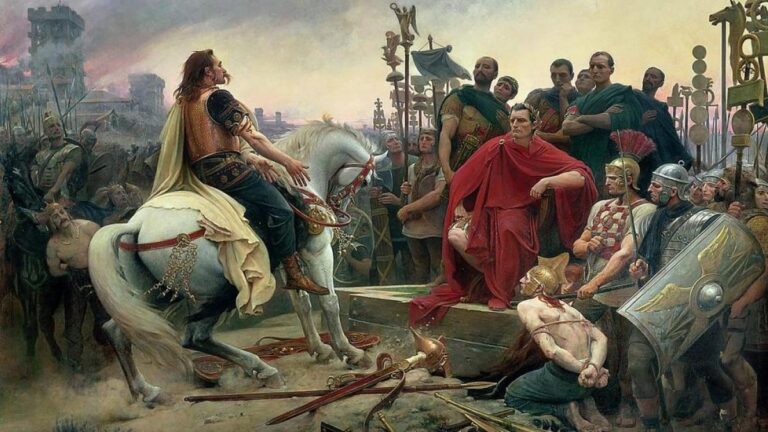
The relationship between Romans and Celts was complex and was marked by several phases of interaction, from conquest to cultural assimilation and the resistance.
Before the Roman expansion, the Celts already inhabited a large part of Europe, especially what is now France (known as Gaul), the British Isles, the Iberian Peninsula, and parts of central and eastern Europe. The Romans had contact with the Celts mainly through early military and commercial incursions.
The Romans began to invade Celtic territories as they expanded their empire. Some of the main stages were the conquest of Gaul (58-50 BC), under the leadership of Julius Caesar, where the fierce resistance of the Gallic warlord Vercingetorix stood out; the conquest of the British Isles, which began in 43 AD under the Emperor Claudius, or the fight against the Celtiberian peoples of Hispania, at the end of the 1st century BC and the beginning of the 1st century AD.
After the conquest, the Celts gradually began to assimilate into Roman culture. This included the adoption of the Latin language, Roman political organization, customs, religion and infrastructure (such as roads and cities).
The theory of Italo-Celtic languages
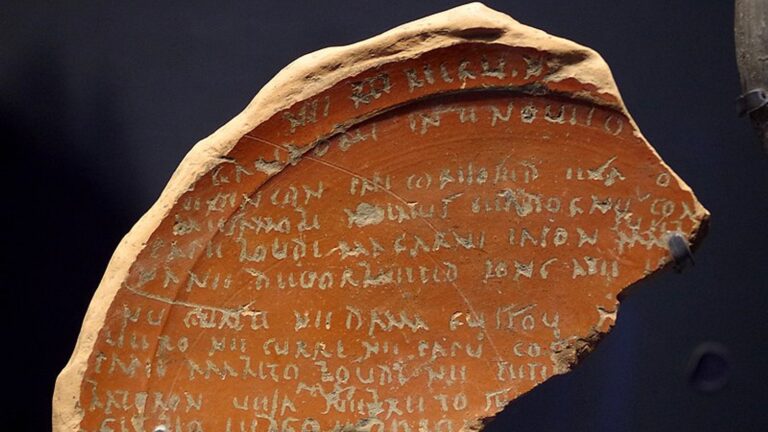
The Italic-Celtic linguistic group constitutes a hypothetical linguistic family that includes Italic and Celtic languages on the basis of characteristics shared by these two branches. One of the main proponents of this theory was the French linguist Antoine Millet (1866-1936), who argued that the Italo-Celtic group of languages had been the third branch to split off from the common Indo-European stock, after Anatolian and Tocharian. This would explain why both Italic and Celtic are two of the most conservative linguistic groups among the Indo-European Lengae.
This theory, therefore, is based on the existence of a series of linguistic features shared by Italic and Celtic, among which the following stand out:
- The assimilation *p > *kʷ. Eg.: from the Proto-Indo-European *penque, gives in Latin quinque (five), and in Irish cu
- The thematic singular genitive in -i, del tipo dominus, -i, occurs in both Italic and Celtic.
- The subjunctive in -a, of the habeas corpus type, which is not known in other Indo-European languages, also occurs in Latin as well as in Celtic.
- The passive form in -r, of the amaris type, is preserved in both linguistic groups.
However, the thesis of Italo-Celtic unity has been much debated in recent years; for, although it is true that these common features exist, some scholars argue that they may have originated due to the long periods of community and neighborhood established between both peoples. Likewise, the existence of numerous exceptions to the rule also calls this theory into question (for example, neither in Celtiberian nor in Osco-Umbrian does the singular genitive occur in -i).
The Celtic lenition
Another of the most interesting features of the Celtic language, because of its possible influence on Romance languages, is the phenomenon of lenition.
Lenition is a linguistic phenomenon that consists of the weakening or softening of certain sounds in a word, generally consonants, when they are found in certain phonological contexts. This weakening can result in the voicing of a voiceless consonant, the fricativization of an occlusive or the disappearance of an already weak phoneme.
According to the hypothesis of the French linguis André Martinet (1908-1999), the regions of Romania (i.e. where Latin had spread) that had had greater contact with Celtic would have experienced this process of lenition to a greater extent during its evolution into Romance.
In this sense, the impact of the lenition was particularly noticeable in the languages of the northwest of the Iberian Peninsula, such as Galician-Portuguese or Asturleonese, areas where the Celtic presence was much greater.
Let us take an example: the Latin term paullum (EN: stick) evolves into the Spanish palo, suffering the phenomenon of disappearance of the geminate (ll > l). However, in Galician the word pau, which indicates that this process of weakening has occurred more strongly, to the point that the consonant has disappeared. This could be due, therefore, to the phenomenon of Celtic lenition.
Ultimately, the problem of Italo-Celtic linguistic unity is ultimately a debate about how to classify and understand the languages of the ancient Indo-European peoples of Europe. Although there is no consensus on a linguistic unity between the Italic and Celtic languages, the cultural and linguistic contact between these groups remains a fascinating topic for scholars of the history of European languages. What is clear is that, despite the scant attention that the study of Celtic has received in comparison with other Indo-European languages, it is evident that its influence was decisive in the evolution not only of Latin but also of some Romance languages.
Carlos Sánchez Luis