

The Library of Alexandria was the most important cultural institution of the ancient world. In addition to being one of the most prestigious libraries of all time, it became one of the greatest centers for the dissemination of knowledge in antiquity.
Although it was not the first great library of the ancient period, for it was part of a long tradition of libraries that existed in both Ancient Greece and the Near East, Alexandria became the center of welcome for intellectuals from all over the Mediterranean, where the most important scientific and literary works of the known world were gathered.
The city of Alexandria
At the beginning of the 3rd century B.C., Egypt was by far the richest country of the different states into which the Empire of Alexander the Great had been divided. The Egyptian kings enjoyed enormous opulence thanks to the abundance of agricultural products they received from the lands of the Nile and exported across the Mediterranean. The court resided in Alexandria, from where a Greek elite ruled over a majority Egyptian population.
The city of Alexandria, founded by Alexander the Great in 331 BC, became the new capital of the Hellenic world. In time, it became the most populous city of antiquity, second only to Rome. It was a city whose greatness and fame were due to three main reasons: firstly, because it housed the most important port complex of the time; secondly, it was the capital of a rich and prosperous kingdom; and finally, it was the intellectual center of the Greek world, mainly due to its Museum and Library.

The Bibliotheca Alexandrina (Βιβλιοθήκη τῆς Ἀλεξάνδρειας)
It was Alexander the Great’s successor in Egypt, King Ptolemy, who decided to found in 295 B.C. the Bibliotheca Alexandrina, known as Bibliotheca Alexandrina, and it seems that his aim was to enrich this space with writings worthy of interest for all nations.
It is known that the library was built in the Brucheion, the palace complex of the city. The site chosen for its construction was next to the Museion –in ancient Greek: Μουσεῖον: «temple of the muses»– the institution on which the library would depend.
It seems relatively clear that the Lyceum of Athens, seat of the Peripatetic school, exerted a great influence on the organization of the library.
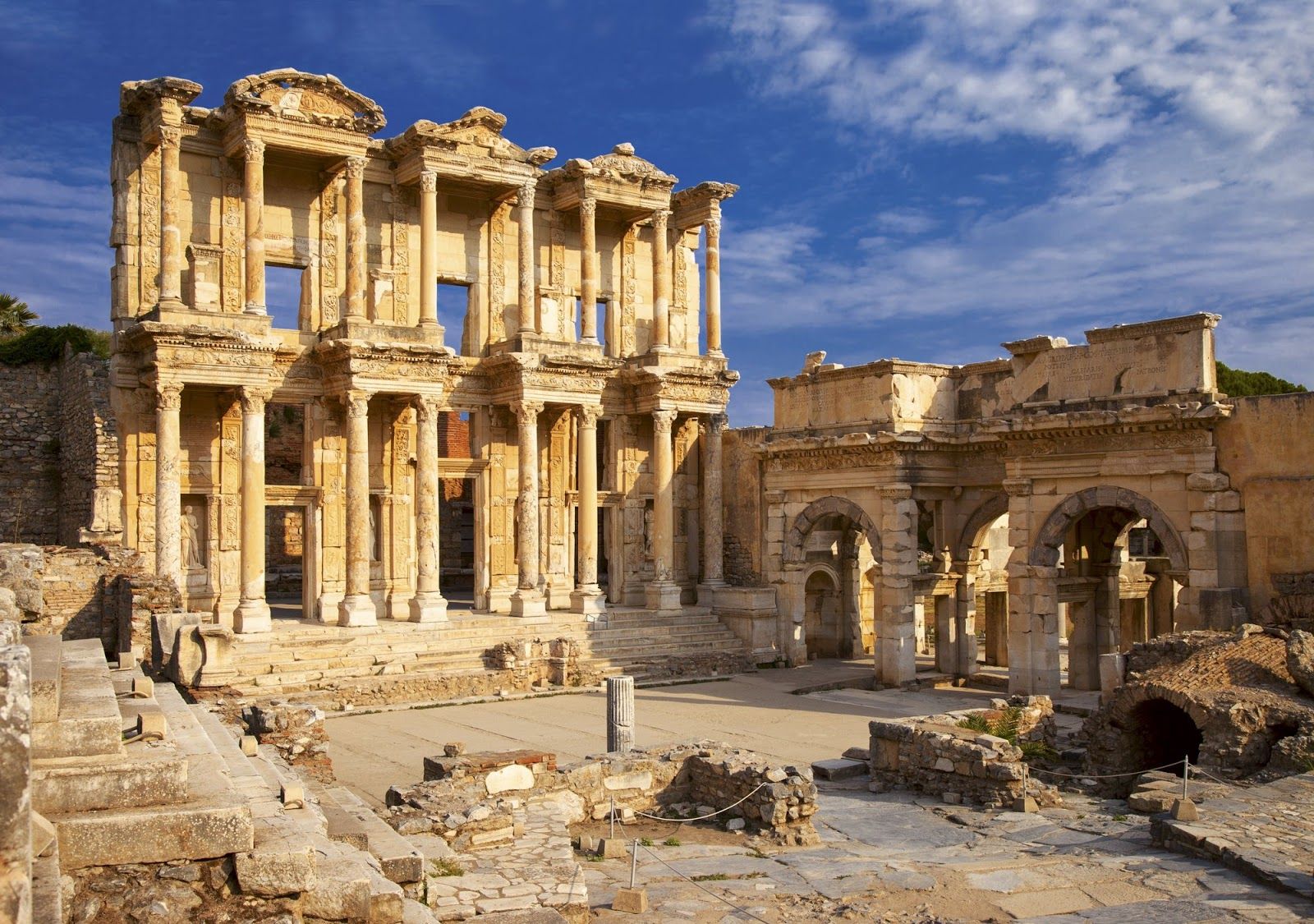
Ancient sources describe the Alexandria Library with Greek columns, walkways, a collective dining room, meeting rooms, gardens and classrooms, a model that would approximate a modern university campus. One of the outbuildings of the complex contained shelves or repositories –Ancient Greek: θήκη– for papyrus scroll collections –Ancient Greek: βιβλίον– which is what was known as the library proper –Ancient Greek: βιβλιοθῆκαι.
Acquisition of books
In order to assemble such an immense bibliographic collection, the Ptolemies initiated an aggressive book acquisition policy. Thus, sometimes they had them requisitioned from ships arriving at the port of Alexandria, and other times they borrowed the books from their owners, with the excuse of copying them and then returning them; however, when the copying work was finished, they returned to the owners the copies made instead of the originals, which remained in the library. On other occasions they opted to buy books instead of requisitioning them, and there were also cases of private donations.
But this was not the only way to acquire books. The Ptolemaic kings sent commercial agents abroad with bags full of gold to buy books in order to include them in the library collection. Many of these books were acquired throughout the Mediterranean in cities such as Athens and Rhodes, which also had important libraries.
On the other hand, in addition to the resources that the library itself possessed, we must add the number of wise men and scholars from all over Greece who were invited by King Ptolemy, and later by his son Ptolemy II (philosophers, writers, historians, mathematicians, astronomers, physicians…), to come to Alexandria and join the Museum.

Sources
We do not have many sources about the Library and its history; in fact, there are few and late news about it. One of the oldest surviving accounts of the founding of the Library is the so-called Aristeas’ letter, a Hellenistic work from the 3rd century B.C. included in the apocryphal books. The work describes the translation into Greek of the Hebrew law by seventy-two translators sent to Egypt from Jerusalem at the request of the librarian of Alexandria, Demetrius Falero.
The rest of the sources are much later, and among them are those of the Roman historians Titus Livius (1st century BC) and Plutarch (1st century AD), and the Roman physician Galen (2nd century AD).
From an archaeological perspective, the remains of the Library have been sought without success. We have no descriptions of the building that housed it or its installations. It is very likely that the lack of information about such facilities is due to the fact that they would not exist as they are conceived today. There was no reading room as such, since the tradition of using a table for reading dates back to the Middle Ages, when the scroll was abandoned in favor of the codex. Likewise, the Greeks used to read aloud, and this activity was carried out in the garden or in the meeting room.
On the other hand, papyrus scrolls were not stored in places similar to those of today, as they were usually kept in jars, chests, baskets or in niches and racks.
Decline and destruction of the Library
It is difficult to pinpoint the exact moment when the destruction of the Library took place, as this event is shrouded in many myths and legends. Probably there was no exact moment of disappearance of the library, but its decadence responded to a progressive process of degradation and abandonment.
The expulsion of Alexandrian scholars by Ptolemy VIII was part of a wider process of persecution of the Alexandrian elite, which led to large numbers of Hellenistic scholars, including such figures as Aristarchus of Samothrace and Apollodorus of Athens.
Thus, in the middle of the second century B.C., the Ptolemaic kingdom of Egypt was shaken by instability, so that the rulers did not devote the same attention to the Museum as their predecessors
However, it seems that the first destruction took place in 48 B.C., during the civil war between the last king of the dynasty, Ptolemy XIII, and Cleopatra. Julius Caesar, who supported the latter, ordered the burning of the ships that besieged him at sea, and, according to Plutarch, the fire spread through the port as far as the Library. Nevertheless, it must have been a partial destruction.
After the death of Cleopatra and the Roman occupation of Egypt, the process of decline of the Library worsened and continued until the 4th century AD. However, the exact date of its destruction or abandonment is not known.
What is clear is that, during the period of greatest activity of the Library of Alexandria, the intellectual culture of the time reached very high levels. It was, above all, a center for the propagation of classical culture, which is the foundation on which our modern civilization is based.
Carlos Sánchez Luis