
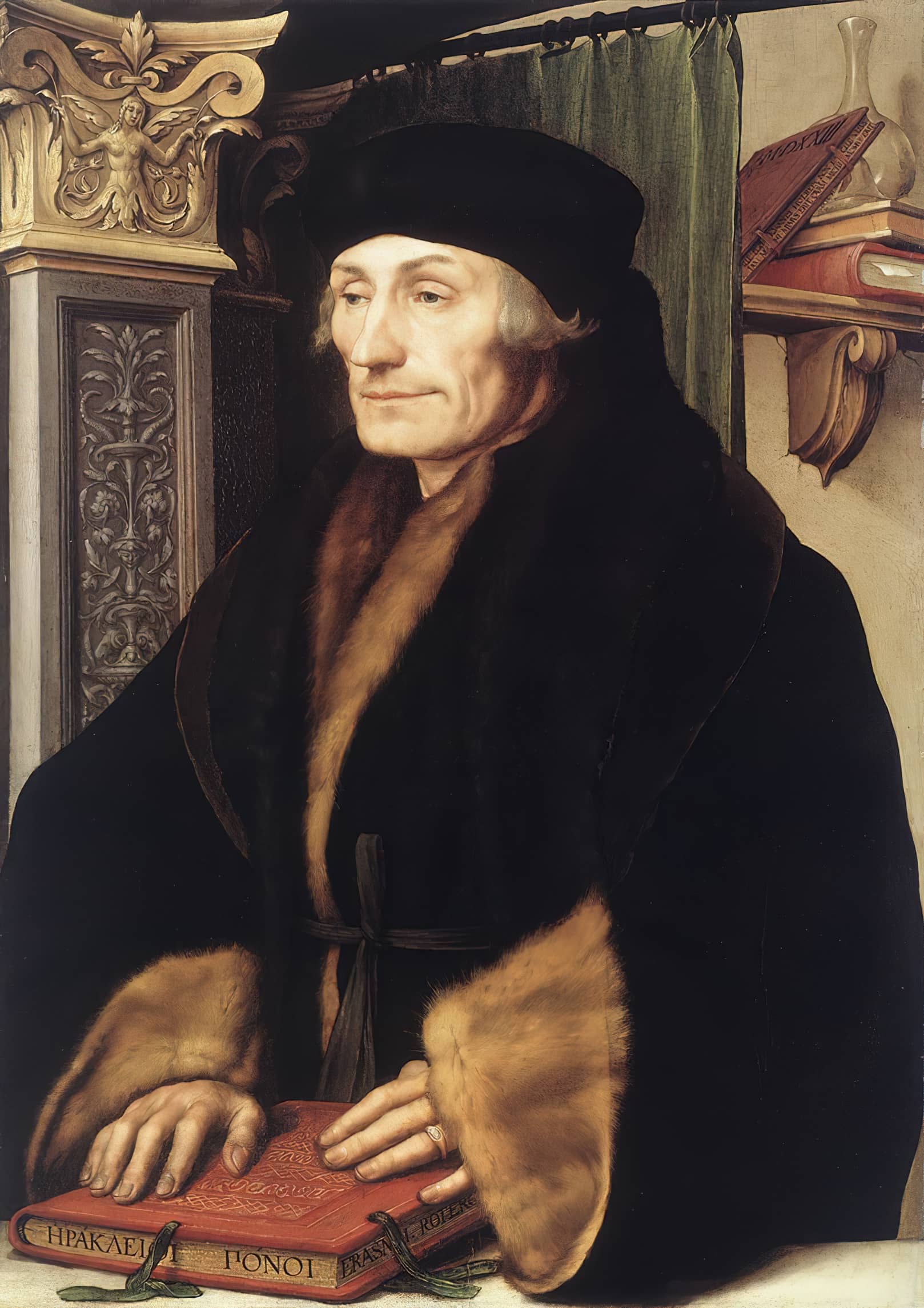
If the new humanists beyond the Alps had focused only on the refined classicism that had characterized the last great Italian representatives, they would have remained obscure and marginal figures. They needed to give the movement a new impetus and demonstrate that its scope was much broader than merely literary. It is in this context that the figure of Erasmus of Rotterdam (1466-1536) appears, who, by 1515, had become the most influential intellectual in Europe, considered by the great men of letters as the highest authority of the emerging humanistic culture.

It is estimated that Desiderius Erasmus was born around 1466 in the city of Rotterdam. After the early death of his parents, Erasmus was sent to a school of the Brethren of the Common Life in the town of Deventer, where he would come into contact with the monastic life. During his stay in the Augustinian convent, he acquired the traditional religious education and was somewhat disenchanted with many of the pious practices, since what really interested him was his intellectual training. Nevertheless, it was there that he began to acquire a great proficiency in the Latin language. Immediately after being ordained a priest, Erasmus began working as secretary to the bishop of Cambrai, who made it possible for him to study theology at the University of Paris, the epicenter of theological studies in Europe. After spending some time in England, where he made friends with renowned figures such as Thomas More, Erasmus returned to Paris, and in 1504 published one of his most famous works, the Enchiridion militis Christiani, which was intended to be a manual of behavior for every man who aspired to be a good Christian.
That same year of 1504, during a summer stay in the city of Louvain, Erasmus had access to the manuscript of the Collatio Novi Testamenti by Lorenzo Valla, of whom he was a fervent admirer, in the abbey of Parc, on the outskirts of the city. Valla had confronted the Greek text with the Latin text of the Vulgate with the intention of correcting it, although in the end he did not leave the Latin translation of the New Testament that he had intended. The reading of this work was the last element that Erasmus needed to complete his religious program: through his philological knowledge, he could undertake a new Latin translation of the New Testament, more refined and closer to the original meaning of the Scriptures. It was a matter of recovering the original message of Christ and returning to the essence of the Holy Scriptures.

It is probably at this culminating moment of Erasmus’ intellectual activity that humanism and Christianity reached their closest meeting point: the practical application of philology and its tools, such as grammar and textual criticism, with the aim of unraveling the sacred text and presenting it as clearly as possible. Erasmus considered it essential to recover the original form of expression of the New Testament through an intensive study of the Holy Scriptures, if possible in the original language (i.e., Greek and Hebrew). Therefore, the new theology sponsored by the humanist placed the Scriptures at the center, since everything was in them. It is in this process of «purification» of Christianity that philological activity becomes especially important, since the core of Erasmian theology resided precisely in language and in the analysis of texts.
Then, from 1500 onwards, Erasmus had already decided to devote himself body and soul to biblical studies, and the idea he had in mind was to correct the Latin version of the New Testament contained in the Vulgate, taking the original Greek as a reference. The extension of the scope of study from Latin to Greek letters was demanded by the subject matter itself, since without the revision of the Greek text it was very difficult to understand many theological questions of early Christianity. The Erasmian idea of knowing the three languages, Latin, Greek and Hebrew, in order to approach biblical studies, was already present in the first precursors of humanism, but it was with Erasmus that it reached a greater degree of maturity. The fruit of this dedication to biblical studies would finally see the light of day in 1516, when the first publication of the so-called Novum Instrumentum, an edition of the Greek text of the New Testament with notes and a Latin translation of his own, which differed from St. Jerome’s Vulgate, was published.

The Novum Instrumentum was, in short, a bilingual edition of the Bible. The Greek text was placed in the left column, and the Latin text in the right column. In fact, the Novum Instrumentum was the second edition of a New Testament in Greek, since the first one to be printed was the Biblia Políglota Complutense, published in 1514 under the direction of Cardinal Cisneros. However, the bilingual edition of the Polyglot did not include a new Latin translation of the New Testament, but only of the Vulgate. In fact, the reception of the first edition of the Erasmian work was somewhat controversial, since some theologians criticized him for offering a translation different from the Vulgate.
This work became the work of a lifetime: its preparation lasted about fifteen years, but the four editions that followed the first printing (1519, 1522, 1527 and 1535) would occupy the rest of his life. Likewise, the Novum Instrumentum became the base text for many modern translations of the New Testament beginning in the 16th century, after the Protestant Reformation.
Erasmus did not get to know Luther personally, nor did he ever adhere to the Protestant Reformation. However, it is clear that some elements of the Erasmian message (such as the theology of Scripture, the yearning for spirituality, the overvaluation of the interior over the exterior, and the critique of ecclesiastical institutions) served as an inspiration for the Lutheran revolution. Luther stated on many occasions that he was a great admirer of Erasmus’ work, especially his translation of the New Testament. Erasmus, for his part, also agreed with some of Luther’s ideas, especially those concerning the administration of the Church.

However, despite these points of common ground, Erasmus and Luther eventually went their separate ways. Among Erasmus’ main objectives was that of harmonizing classical culture with the Christian religion, reason with revelation, a position shared with other humanists such as Luis Vives or Thomas More. His character was conciliatory, moderate and eclectic, a defender of a sense of spirituality in which the moral component had an outstanding importance. Luther, on the other hand, had a markedly religious inclination and was much more radical in his approach: in his tireless search for interiority, he sought to lay the foundations for a genuine intellectual revolution. Thus, unlike Erasmus, his sense of religiousness was deeply existential and agonizing.
Carlos Sánchez Luis