
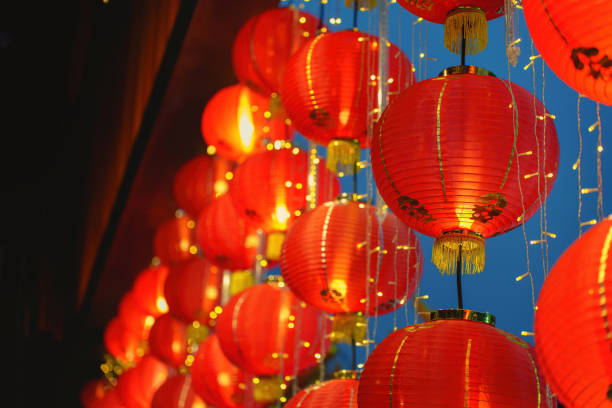
The Chinese New Year is one of the most important celebrations in Chinese culture, marked by a mixture of tradition, symbols and customs that reflect the cycle of nature and the hope for a prosperous future. Although most of us refer to this celebration as “Chinese New Year”, in this country, the event is mostly known as “Spring Festival”. It does not have a fixed date, since it is based on the lunisolar calendar, that is, the one that indicates the time taking as a reference both the phases of the Sun and the Moon.
This year, 2025, the Chinese New Year took place on January 29th, which marks the beginning of the Year of the Wood Snake, and will last until February 26th, 2026. But what is this “Wood Snake”? And for the Chinese is it also the year 2025, or do they use another reference date in their calendar?
The Chinese calendar
As we have already mentioned, the Chinese calendar is of the lunisolar type. The months are lunar, i.e., the first day is the new moon and the 15th day is the full moon; since in a solar year there are twelve lunar months and, in addition, a dozen days, seven months are added over nineteen years to compensate, thus adjusting it to the single calendar.
To know the current year of the Chinese calendar, it is necessary to determine the era in which this civilization is located. An era is a period of time that is counted from an important event. For example, in Western civilization, we use the birth of Christ (year 1) as a reference point, and from there, we calculate “backwards” (B.C.) or “forwards” (A.D.) to date events.
As in our calendar —which we call “Gregorian”—, the use of eras in the Chinese calendar system establishes a chronological starting point from which the continuous numbering of subsequent or preceding dates begins. One of the most widespread reference milestones is the Year of the Yellow Emperor, i.e. the year in which this legendary emperor, one of the most important figures in Chinese mythology, supposedly began to reign. In our era, this year would be approximately 2967 B.C., so that, if taken as a reference, the Chinese would currently be in the year 4722.
However, there are other reference dates in the Chinese culture to fix the calendar, such as the Year of Confucius (551 B.C.) or the Year of Emperor Yao (2156 B.C.), but there is no general consensus on this respect. In fact, the most popular at present is the date set in the Gregorian calendar.
The signs of the Zodiac and the Yin-Yang
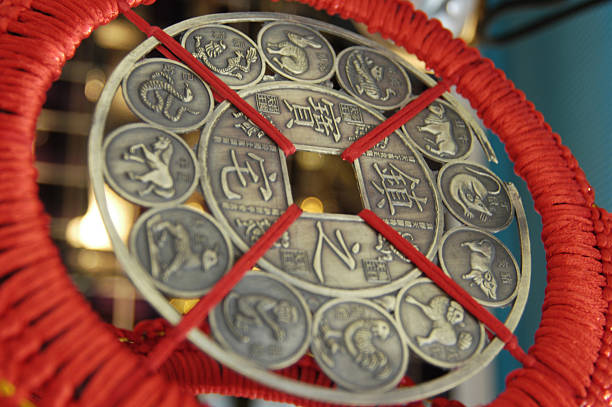
The Chinese astrology defines the astrological system characteristic of the Chinese calendar, particularly its twelve annual cycles of animals, known as the Chinese zodiac. Each year in the Chinese calendar is associated with a specific animal, and it is believed that people born during that year acquire some of the characteristics or energies associated with that animal. The twelve animals are: the rat, the ox, the tiger, the rabbit, the dragon, the snake, the horse, the goat, the monkey, the rooster, the dog and the pig.
In turn, each animal of the Chinese zodiac is associated with one of the five elements: wood, fire, earth, metal and water. These are modifiers and affect the characteristics of each of the twelve signs.
There is also a binary cycle, the yin-yang, which, together with the cycle of the five elements, forms a cycle of ten elements. Yin and yang are two concepts in Taoism used to refer to the two opposing and complementary fundamental forces that exist in nature —yin is the feminine principle, earth, darkness, passivity and absorption, while yang represents the masculine principle, heaven, light, activity and penetration—. Even years are yang, and odd years are yin. When the zodiac cycle of the twelve animals is divided into two, each zodiac can occur only in yin or yang: the dragon is always yang, the snake is always yin, etc. This combination creates a 60-year cycle, starting from Wood Rat and ending with Water Pig. The current cycle began in the year 1984, being currently in the year of the Wood Snake.

Chinese New Year celebrations and traditions
The Chinese New Year is an occasion for families to gather together. New Year’s Eve (the night before the lunar new year begins) is especially important, and many people travel long distances to be with their loved oness. New Year’s Eve (the night before the lunar new year begins) is especially important, and many people travel long distances to be with their loved ones. Red clothing, especially underwear, is traditionally chosen for its link to protection against evil spirits and the attraction of good luck (a tradition that has spread to other parts of the world).
One of the most famous symbols of the Chinese New Year is the red envelopes, called laih sih or ang pau. Money is placed inside these envelopes and given as gifts to children, single young people, employees or people close to them. This gesture symbolizes the wish for prosperity and good luck for the recipient.
Fireworks are an essential part of the Chinese New Year celebrations. It is believed that the noise of firecrackers chases away evil spirits and bad luck, opening the way for a new year full of good fortune.
The lion dance and the dragon dance are traditional dances performed during New Year celebrations. These dances are performed by teams that dress up as lions and dragons and, to the beat of drums and other musical instruments, perform acrobatics and synchronized movements. The dragon, in particular, is associated with power and good luck, and the dance is performed to attract prosperity.
The Chinese New Year is, in short, a holiday of great cultural, economic and social importance, celebrated not only in China, but also in many other parts of the world. Through traditional rituals and celebrations, family ties are renewed and a new cycle of hope and prosperity is welcomed. Associated with the Chinese zodiac, each year carries with it the characteristics of an animal that influences the year’s expectations, reflecting Chinese culture’s deep connection to astrology. At its core, the Chinese New Year is a time to reflect, renew energies and strengthen ties between people and communities.
Carlos Sánchez Luis